
The Critical Role of Certified Reference Materials in Ensuring Laboratory Proficiency for Special Dietary Foods
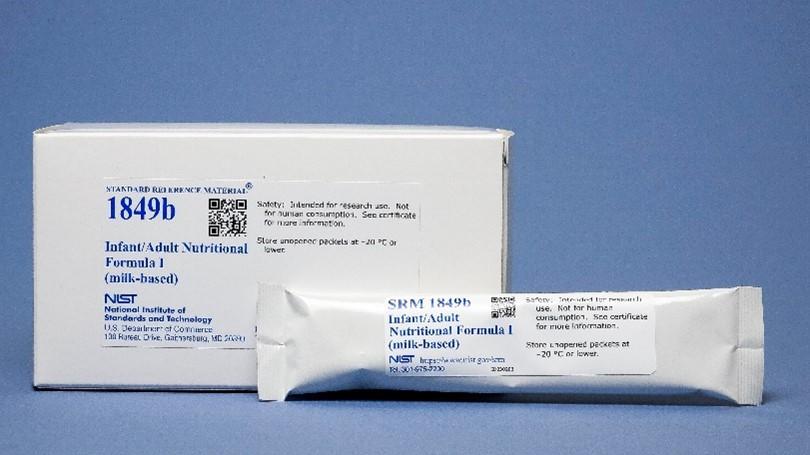
Image credit: National Institute of Standards and Technology (NIST)
Written by: Erik Konings and Dustin Starkey
A Certified Reference Material (CRM) is defined as a Reference material characterized by a metrologically valid procedure for one or more specified properties, accompanied by a certificate that provides the value of the specified property, its associated uncertainty, and a statement of metrological traceability (ISO Guide 30: 2015).
Standard Reference Material (SRM) in a registered trade mark of the US National Institute of Science and Technology (NIST) and is used by that organisation to refer to CRMs produced by NIST that meet additional NIST-specific certification criteria. SRMs may also deliver non-certified information.
CRMs are materials that have been thoroughly characterized, measured, and certified for one or more physical or chemical properties to calibrate and validate measurement instruments and methods. CRMs are offered by National Metrology Institutes such as NIST in the United States, or the Korea Research Institute of Standards and Science (KRISS).
The Joint Research Centre (JRC) of the European Commission is a major provider of certified reference materials (CRMs) for food safety in Europe.
Why is it important to use Certified Reference Materials
Infant formula and related nutritional products are among the most regulated foods globally, with strict statutory requirements. Laboratories analyzing these products must prove that their methods reliably quantify critical nutrients, minerals, vitamins, and potential contaminants.
Because special dietary products often serve vulnerable populations such as newborns, toddlers, and individuals requiring medical nutrition, the analytical methods used to assess their content must be validated with exceptional rigor.
Using CRMs allows laboratories to:
- Demonstrate proficiency in executing standardized test methods.
- Verify method accuracy and precision during method development, validation, verification, and routine QC.
- Ensure comparability across labs, supporting regulatory compliance and harmonization.
- Improve confidence in measurements reported on product labels and regulatory submissions.
The table below gives examples of available CRMs and SRMs in the area of Special Dietary Foods.
|
Material number |
Material |
Certified values for |
Provider |
Links to purchase |
|
SRM 1849b |
Infant/Adult Nutritional Formula I, milk based |
Elements, vitamins, and other nutritional components |
NIST |
|
|
SRM 1869 |
Infant/Adult Nutritional Formula II, milk/whey/soy based |
Vitamins, minerals, choline, carnitine, and cholesterol |
NIST |
|
|
CRM No. : 108-02-003 |
Infant Formula |
Vitamins, fatty acids |
KRISS |
|
|
ERM-BD087 |
Infant Formula |
3-MCPD fatty acid esters, 2-MCPD fatty acid esters, Sum of 3-MCPD and 3-MCPD fatty acid esters, Sum of 2-MCPD and 2-MCPD fatty acid esters |
JRC |
Search Articles
Categories
No categories yet
Recent Posts
The Critical Role of Certified Reference Materials in Ensuring Laboratory Proficiency for Special Dietary Foods

Fit for purpose: How analytical methods keep nutrition products safe

New one-stop-shop Test Methods website provides a comprehensive and authoritative guide to analytical methods for special dietary foods
Stay Updated
Subscribe to get the latest updates.